

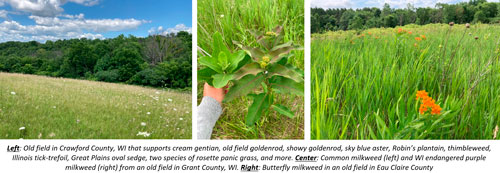
If you have an old field that you would like to plant to prairie or a stand of oak you would like to restore, don’t rush into it. Understand the history of the land and take time to observe and learn whether anything important remains. Very often degraded lands still harbor irreplaceable elements of biodiversity, and these have their own stories to tell about what a place was and could be. The tools we use in restoration can encourage these elements or extinguish them. By recognizing and preserving remnant populations of native species and their genes, we can counteract biotic homogenization[i], and sometimes we can reduce project complexity and expense in the process.
Many landowners with prairie planting projects in old fields or retired pastures already have important elements of the biodiversity they are trying to restore, many of which are commercially unavailable. Occasionally remnant populations of rare plants persist. Even areas that were formerly cultivated often support good prairie, savanna, and oak woodland species that have recolonized from the edges, or perhaps a neighboring oak savanna that has since become forest. In many cases as many desirable native species remain as would be required for a seed mix planted under a cost-share program! I have included a table with upland species often encountered in old fields and pastures; there are many more. It is not uncommon to encounter five to fifteen of these species in an old field and ten to twenty of them in a retired pasture.
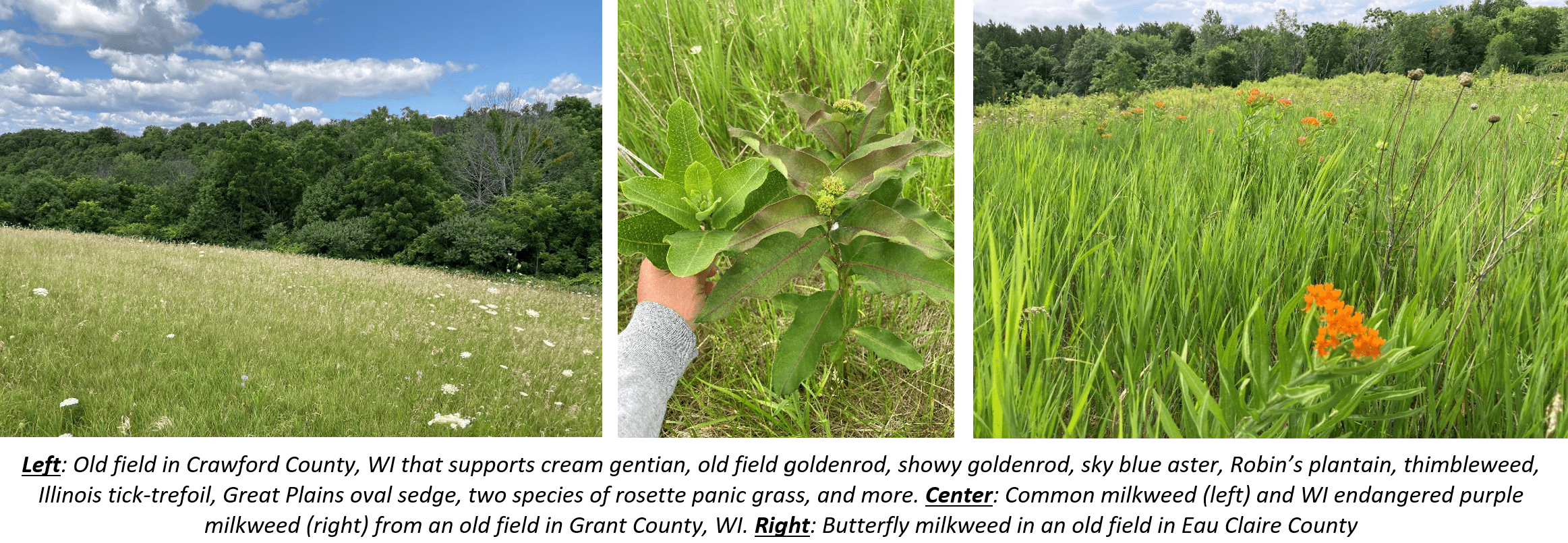
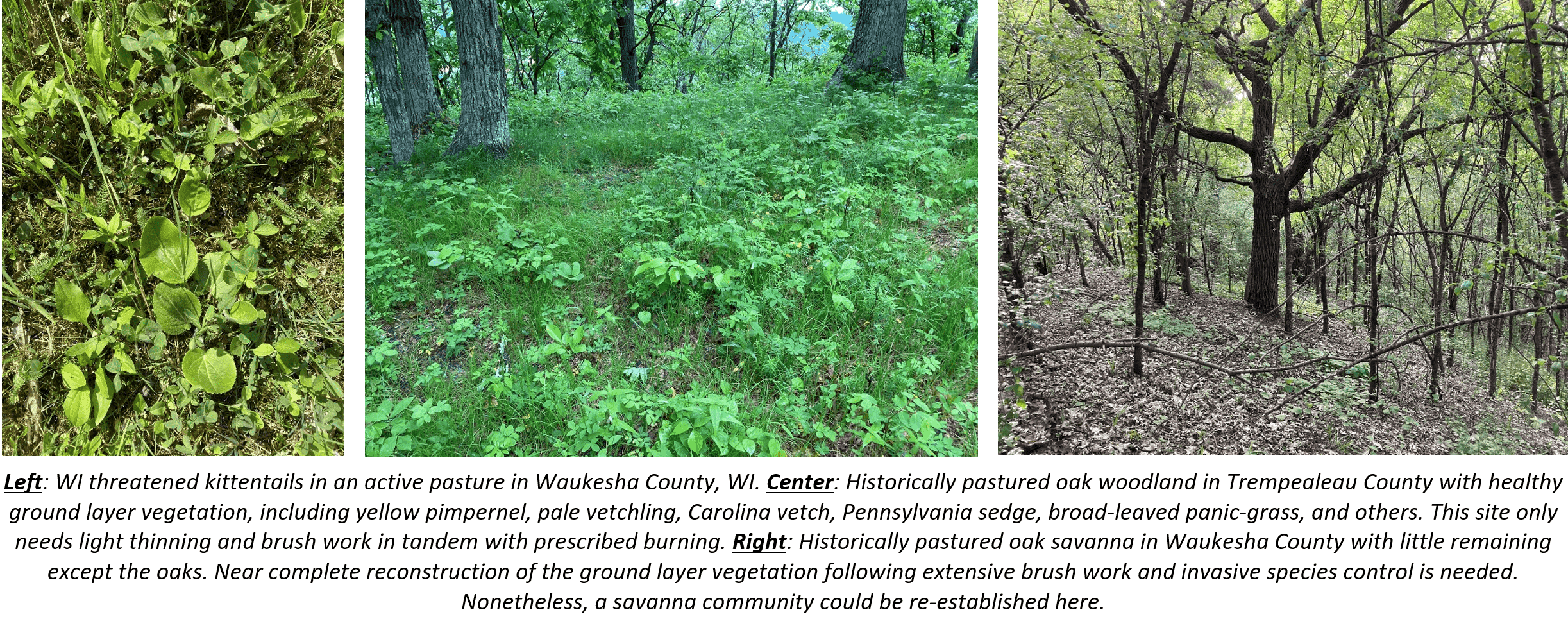
In cases where there are some good things present, start by managing these areas as though they were still prairie. Selectively control encroaching woody vegetation and any patches of broad-leaved herbaceous weeds. Burn for a couple consecutive years during the dormant season to encourage anything good that might be suppressed by the thatch. See what happens and go from there, which will usually mean integrating inter-seeding, a lot of burning, and patience.
Many landowners with wooded ground have land that was once oak woodland, oak savanna, or oak barrens. Oak woodlands are conservation-worthy and rare, but they are sometimes mistaken for forests or inappropriately treated as savannas[i] or barrens. It is far more common to encounter structurally intact ground layer vegetation in heretofore unrestored woodlands than open savannas. In oak woodlands, good cover of Pennsylvania sedge or dry-spiked sedge often remains, and species that tend to favor dappled light vs. deep shade or full sun—poke milkweed, pale vetchling, yellow pimpernel, broad-leaved panic-grass, bearded shorthusk, purple Joe-pye weed, Carolina vetch, etcetera—are often still present. Even where oak woodlands have become shadier, that change has usually been more gradual and less in degree than in savannas. This has allowed more of the woodland vegetation to hang on. Where a low sedgy or grassy ground layer remains, restoration might only involve modest brush work, removal non-oak understory hardwoods, non-oak overstory thinning/girdling, restoration of fire, and modest inter-seeding of missing species over time. Savanna restoration is critically important where true opportunities still exist, but good opportunities to restore oak woodland seem to be more common than savanna.
If you have an open area of cool-season grass or a stand of oak, I encourage you to take a closer look. You might discover there is more opportunity, or a different opportunity, than you initially thought. If you are looking for cost-share, go shopping for assistance that helps to build on what remains. Doing so should result in projects that conserve more community, species, and genetic diversity on the landscape.
Rich Henderson’s presentation “Converting Pasture to Prairie” on YouTube is an excellent resource.
______
i- Biotic homogenization is the process by which spatially separate ecological communities become more similar over time as the result of extinctions and invasions (or introductions).
ii- I use ‘savanna’ here in place of ‘oak opening’ for relatively open communities with mostly widely spaced, open-grown oak trees with prairie vegetation in-between.
______
| Species | Common Name and Notes |
| Andropogon gerardii | Big bluestem |
| Antenneria spp. | Pussytoes |
| Aristida spp. | Three-awn grasses |
| Asclepias amplexicaulis | Clasping-leaf milkweed, sandy sites |
| Asclepias syriaca | Common milkweed |
| Asclepias tuberosa | Butterfly milkweed, sandy sites |
| Asclepias verticillata | Whorled milkweed |
| Besseya bullii | Kittentails, P |
| Bouteloua spp. | Gramma grasses, P |
| Carex brevior | Great Plains oval sedge |
| Carex gravida | Heavy sedge |
| Carex normalis | Greater straw sedge |
| Carex umbellata | Parasol sedge |
| Cirsium discolor | Prairie thistle |
| Crocanthemum spp. | Frostweeds, sandy sites |
| Desmodium canadense | Showy tick-trefoil |
| Desmodium illinoense | Illinois tick-trefoil |
| Dichanthelium spp. | Rosette panic-grasses |
| Erigeron pulchellus | Robin’s plantain |
| Fragaria virginiana | Virginia wild strawberry |
| Gentiana alba | Cream gentian |
| Lathyrus venosus | Veiny Pea, P |
| Lechea spp. | Pinweeds, sandy sites |
| Lespedeza capitata | Round-headed bushclover |
| Lithospermum caroliniense | Hairy puccoon, sandy sites |
| Lobelia spicata | Pale-spiked lobelia, P |
| Lysimachia lanceolata | Lance-leaved loosestrife, sandy sites |
| Monarda fistulosa | Bergamot |
| Oenothera perennis | Small sundrops, P |
| Packera paupercula | Balsam ragwort, P |
| Penstemon gracilis | Lilac beardtongue, sandy sites |
| Primula meadia | Midland shooting star, P |
| Pycnanthemum virginianum | Mountain mint |
| Ranunculus fascicularis | Early buttercup, P |
| Ratibida pinnata | Yellow coneflower |
| Rudbeckia hirta | Black-eyed Susan |
| Schizachyrium scoparium | Little bluestem |
| Solidago juncea | Early goldenrod |
| Solidago nemoralis | Old field goldenrod |
| Solidago rigida | Stiff goldenrod |
| Solidago speciosa | Showy goldenrod |
| Sorghastrum nutans | Indiangrass |
| Symphyotrichum oolentangiense | Sky-blue aster, P |
| Tradescantia ohiensis | Ohio spiderwort |
| Verbena stricta | Hoary vervain |
| Viola sagittata | Arrow-leaved violet |
‘P’ used for species more often found in pastures than old fields
[i] I use ‘savanna’ here in place of ‘oak opening’ for relatively open communities with mostly widely spaced, open-grown oak trees with prairie vegetation in-between.